Address
304 North Cardinal St.
Dorchester Center, MA 02124
Work Hours
Monday to Friday: 7AM - 7PM
Weekend: 10AM - 5PM

Address
304 North Cardinal St.
Dorchester Center, MA 02124
Work Hours
Monday to Friday: 7AM - 7PM
Weekend: 10AM - 5PM


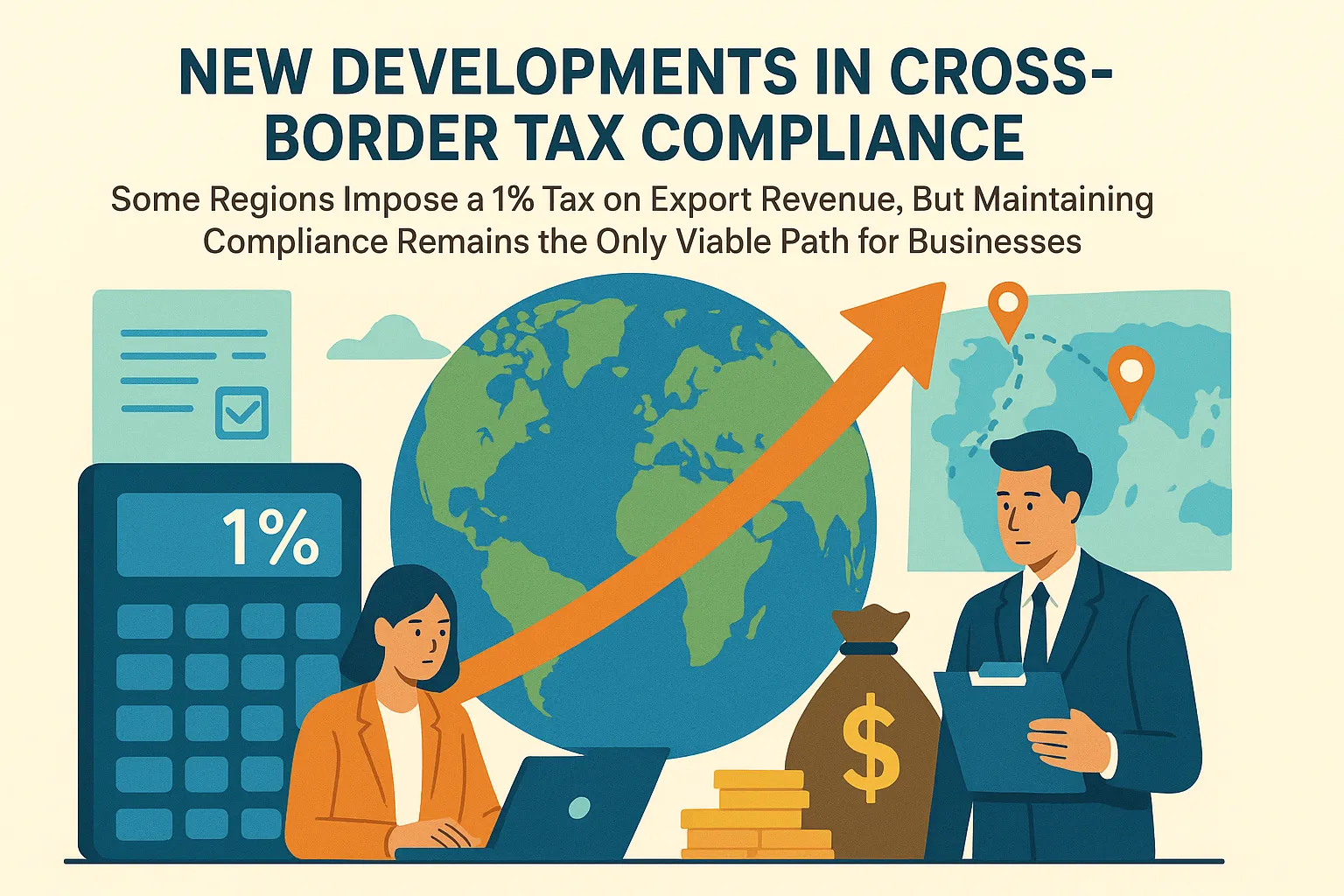
For U.S. Amazon sellers and e-commerce brands, recent changes in international tax regimes — including reports that some regions levy a 1% tax on export revenue — make it essential to treat cross-border tax compliance as a foundational part of your expansion strategy. This article explains the new developments, their commercial implications, and concrete steps to stay compliant and profitable.
Cross-border tax compliance encompasses the obligations sellers face when transacting across jurisdictions: export taxes, VAT/GST registration, customs duties, digital reporting, transfer pricing and potential permanent establishment risk. As tax authorities expand data collection and enforcement, sellers must track revenue by jurisdiction and meet local filing obligations to avoid fines, blocked shipments or marketplace suspensions.
Some regions are now adopting taxes directly tied to export revenue. Although specifics vary by jurisdiction (and not all countries follow the same model), the rise of a 1% export-revenue tax highlights new operating costs for sellers who generate sales abroad.
Example: $1,000,000 of export sales to a jurisdiction with a 1% export tax yields a $10,000 tax obligation — a non-trivial cost that must be modelled into pricing and promotional planning.
Non-compliance is not a cost-saving strategy — it’s a growth-limiting risk. Sellers who ignore emerging cross-border taxes, VAT obligations, or customs requirements may face retrospective liabilities, penalties, account suspensions, or closed market access.
Sellers who embed compliance into market entry and operations can scale reliably, win trust from partners and customers, and avoid costly surprises. Compliance becomes a differentiator — not merely an expense.
Below is a practical checklist to prepare and respond to the new cross-border tax landscape:
Identify where you generate export revenue (marketplaces, FBA locations, drop-ship routes) and quantify revenue by jurisdiction to detect tax exposure.
Incorporate export-revenue taxes (e.g., 1%), VAT/GST and duties into landing cost and re-test price points to preserve target margins.
Determine whether local tax registrations or periodic filings are required. Engage local tax counsel or a compliance partner when rules are unclear.
Use tax engines, invoice automation and bookkeeping that tag transactions by jurisdiction. Manual processes break at scale and increase audit risk.
If compliance costs significantly erode margin, consider localising production, changing fulfilment strategies, or repositioning products to protect profitability.
Staying informed and proactive will be essential as regulators and marketplaces iterate on rules.
New developments in cross-border tax compliance — including the emergence of a 1% tax on export revenue in some regions — change the economics of international selling. For U.S. Amazon sellers and e-commerce brands, the practical takeaway is clear: maintaining compliance remains the only viable path to sustainable global expansion. Compliance should be integrated into pricing, fulfilment and market entry planning from day one.
We’ll map your export revenue, model tax impact (including export taxes), and build a compliance roadmap to protect margin and market access.
The adoption of export-revenue taxes varies and is evolving. Some jurisdictions have piloted or proposed levies around 1%; sellers must check local rules for each market they serve.
Changing fulfilment (local warehouses, different routing) can affect tax exposure, but it often triggers other obligations (local VAT, customs, permanent establishment risk). Analyse with tax counsel before making structural changes.
Start by mapping export revenue by country, update your landed-cost models, and consult a tax advisor for registration and filing obligations. Even small sellers benefit from basic automation and recordkeeping.
